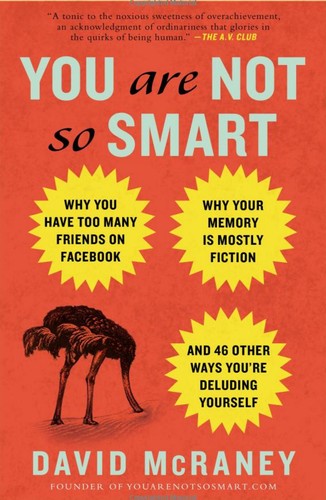
The Book in Three Sentences
- We have no clue why you act the way we do, choose the things we choose or think the thoughts we think
- Our errors in thinking are caused by cognitive biases, heuristics, and logical fallacies
- We can better deal with these biases once we understand them
The Five Big Ideas
- We think we know how the world works, but we really don’t
- We narratives to explain why we do what we do
- Cognitive biases are predictable patterns of thought and behavior that lead us to draw incorrect conclusions
- Heuristics are mental shortcuts we use to solve common problems
- Logical fallacies are like maths problems involving language, in which you skip a step or get turned around without realizing it
You Are Not So Smart Summary
- “There is a growing body of work coming out of psychology and cognitive science that says you have no clue why you act the way you do, choose the things you choose or think the thoughts you think.”
- “From the greatest scientist to the most humble artisan, every brain within every body is infested with preconceived notions and patterns of thought that lead it astray without the brain knowing it.”
- “You are naturally hindered into thinking in certain ways and not others, and the world around you is the product of dealing with these biases, not overcoming them.”
- “Cognitive biases are predictable patterns of thought and behavior that lead you to draw incorrect conclusions.”
- “Heuristics are mental shortcuts you use to solve common problems. They speed up processing in the brain, but sometimes make you think so fast you miss what is important.”
- “Logical fallacies are like maths problems involving language, in which you skip a step or get turned around without realizing it … They are arguments in your mind where you reach a conclusion without all the facts because you don’t care to hear them or have no idea how limited your information is.”
- “Logical fallacies can also be the result of wishful thinking.”
1. Priming
- Priming is when a stimulus in the past affects the way you behave and think or the way you perceive another stimulus later on. (Sam: Dan Ariely discusses priming at length in his book, Predictably Irrational.)
- “Priming works best when you are on autopilot when you aren’t trying to consciously introspect before choosing how to behave.”
- “You can’t self-prime, not directly. Priming has to be unconscious; more specifically, it has to happen within what psychologists refer to as the adaptive unconscious—a place largely inaccessible.”
- Often, we are unaware of how unaware we are.
- “Priming works only if you aren’t aware of it, and those who depend on priming to put food on the table work very hard to keep their influence hidden.”
- “You are most open to suggestion when your mental cruise control is on or when you find yourself in unfamiliar circumstances.”
2. Confabulation
- Confabulation describes our tendency to ignore our motivations and create fictional narratives to explain our decisions, emotions, and history without realizing it.
3. Confirmation Bias
- “When the frequency illusion goes from a passive phenomenon to an active pursuit, that’s when you start to experience confirmation bias.”
- Confirmation bias occurs when you perceive the world through a filter, thinking selectively.
- Put simply, you want to be right about how you see the world, so you seek out information that confirms your beliefs and avoid contradictory evidence and opinions.
- “People like to be told what they already know.”
4. Hindsight Bias
- We often look back on the things we’ve just learned and assume we knew them or believed them all along. This is known as hindsight bias.
- “You are always looking back at the person you used to be, always reconstructing the story of your life to better match the person you are today.”
- “Hindsight bias is a close relative of the availability heuristic.”
- “The availability heuristic shows you make decisions and think thoughts based on the information you have at hand while ignoring all the other information that might be out there.”
- “You do the same thing with Hindsight Bias, by thinking thoughts and making decisions based on what you know now, not what you used to know.”
5. The Texas Sharpshooter Fallacy
- “Picking out clusters of coincidence is a predictable malfunction of normal human logic.”
- “If hindsight bias and confirmation bias had a baby, it would be the Texas sharpshooter fallacy.”
- “Anywhere people are searching for meaning, you will see the Texas sharpshooter fallacy.”
- “You commit the Texas sharpshooter fallacy when you need a pattern to provide meaning, to console you, to lay blame.”
6. Procrastination
- “Procrastination is all about choosing want over should because you don’t have a plan for those times when you can expect to be tempted.”
- “Faced with two possible rewards, you are more likely to take the one that you can enjoy now over one you will enjoy later—even if the later reward is far greater.”
- “One of the best ways to see how bad you are at coping with procrastination is to notice how you deal with deadlines.”
- “If you fail to believe you will procrastinate or become idealistic about how awesome you are at working hard and managing your time, you never develop a strategy for outmaneuvering your own weakness.”
- “You must be adept at thinking about thinking to defeat yourself at procrastination.”
- The trick to overcoming procrastination is to accept that the now-you will not be the person facing those choices, it will be the future-you—a person who can’t be trusted. Future-you will give in, and then you’ll go back to being now-you and feel weak and ashamed. Now-you must trick future-you into doing what is right for both parties.
7. Normalcy Bias
- “No matter what you encounter in life, your first analysis of any situation is to see it in the context of what is normal for you and then compare and contrast the new information against what you know usually happens … Because of this, you have a tendency to interpret strange and alarming situations as if they were just part of business as usual.”
- “In any perilous event, like a sinking ship or a towering inferno, a shooting rampage or a tornado, there is a chance you will become so overwhelmed by the perilous overflow of ambiguous information that you will do nothing at all.”
- “Normalcy bias is stalling during a crisis and pretending everything will continue to be as fine and predictable as it was before.”
8. Introspection
- The origin of certain emotional states is unavailable to you, and when pressed to explain them, you will just make something up. This is called the introspection illusion.
9. The Availability Heuristic
- The availability heuristic describes our tendency to react more rapidly and to a greater degree when considering information you are familiar with.
- “The old adage ‘I’ll believe it when I see it’ is the availability heuristic at work.”’
- “It’s simply easier to believe something if you are presented with examples than it is to accept something presented in numbers or abstract facts.”
10. The Bystander Effect
- The more people who witness a person in distress, the less likely it is that any one person will help. This is known as the bystander effect.
- “Whether it is to donate blood, assist someone in changing a tire, drop money into a performer’s coffers, or stop a fight—people rush to help once they see another person leading by example.”
11. The Dunning-Kruger Effect
Here’s how McRaney describes the Dunning-Kruger Effect
The more skilled you are, the more practice you’ve put in, the more experience you have, the better you can compare yourself to others. As you strive to improve, you begin to better understand where you need work. You start to see the complexity and nuance; you discover masters of your craft and compare yourself to them and see where you are lacking. On the other hand, the less skilled you are, the less practice you’ve put in, and the fewer experiences you have, the worse you are at comparing yourself to others on certain tasks. Your peers don’t call you out because they know as little as you do, or they don’t want to hurt your feelings.
The more skilled you are, the more practice you’ve put in, the more experience you have, the better you can compare yourself to others. As you strive to improve, you begin to better understand where you need work. You start to see the complexity and nuance; you discover masters of your craft and compare yourself to them and see where you are lacking. On the other hand, the less skilled you are, the less practice you’ve put in, and the fewer experiences you have, the worse you are at comparing yourself to others on certain tasks. Your peers don’t call you out because they know as little as you do, or they don’t want to hurt your feelings.
“If you want to be great at something, you have to practice, and then you have to sample the work of people who have been doing it for their whole lives.”
12. Apophenia
- “Coincidences are a routine part of life, even the seemingly miraculous ones. Any meaning applied to them comes from your mind. This is known a apophenia.”
13. Brand Loyalty
- “You prefer the things you own because you rationalize your past choices to protect your sense of self. This is called brand loyalty.”
14. The Argument from Authority
- “When you see the opinions of some people as better than others on the merit of their status or training alone, you are arguing from authority.”
15. The Argument from Ignorance
- The argument from ignorance is when you decide something is true or false because you can’t find evidence to the contrary.
- “You don’t know what the truth is, so you assume any explanation is as good as another.”
16. The Straw Man Fallacy
- “When you get into an argument about either something personal or something more public and abstract, you sometimes resort to constructing a character who you find easier to refute, argue, and disagree with, or you create a position the other person isn’t even suggesting or defending.”
- “Any time someone begins an attack with ‘So you’re saying we should all just . . .’ or ‘Everyone knows . . . ,’ you can bet a straw man is coming.”
17. The Ad Hominem Fallacy
- “When you assume someone is incorrect based on who that person is or what group he or she belongs to, you have committed the ad hominem fallacy.”
18. The Just-World Fallacy
- “When you hear about a situation you hope never happens to you, you tend to blame the victim, not because you are a terrible person but because you want to believe you are smart enough to avoid the same fate.”
- “It is common in fiction for the bad guys to lose and the good guys to win. This is how you would like to see the world—just and fair. In psychology, the tendency to believe that this is how the real world works is called the just-world fallacy.”
- “You want the world to be fair, so you pretend it is.”
19. The Public Goods Game
- “The public goods game suggests regulation through punishment discourages slackers.”
20. The Ultimatum Game
- “When it comes to making a deal, you base your decision on your status.”
21. Subjective Validation
- “You are prone to believing vague statements and predications are true, especially if they are positive and address you personally.”
- “The tendency to believe vague statements designed to appeal to just about anyone is called the Forer effect, and psychologists point to this phenomenon to explain why people fall for pseudoscience like biorhythms, iridology, and phrenology, or mysticism like astrology, numerology, and tarot cards.”
- The Forer effect is part of a larger phenomenon psychologists refer to as subjective validation, which is a fancy way of saying you are far more vulnerable to suggestion when the subject of the conversation is you.
22. Cult Indoctrination
- “Cults are populated by people just like you.”
- “The research on cults suggests you don’t usually join for any particular reason; you just sort of fall into them the way you fall into any social group.”
23. Groupthink
- “The desire to reach consensus and avoid confrontation hinders progress.”
- “For a group to make good decisions, they must allow dissent and convince everyone they are free to speak their mind without risk of punishment.”
- “True groupthink depends on three conditions—a group of people who like one another, isolation, and a deadline for a crucial decision.”
- “When groups get together to make a decision, an illusion of invulnerability can emerge in which everyone feels secure in the cohesion. You begin to rationalize other people’s ideas and don’t reconsider your own. You want to defend the group’s cohesion from all harm, so you suppress doubts, you don’t argue, you don’t offer alternatives—and since everyone is doing this, the leader of the group falsely assumes everyone is in agreement.”
24. Supernormal Releasers
- A supernormal releaser is an exaggerated version of a stimulus to which there is an existing response tendency, or any stimulus that elicits a response more strongly than the stimulus for which it evolved.
25. The Affect Heuristic
- “The tendency to make poor decisions and ignore odds in favor of your gut feelings is called the affect heuristic.”
- “The affect heuristic is one way you rapidly come to a conclusion about new information.”
- “When first impressions linger and influence how you feel about second, third, and fourth impressions, you are being befuddled by the affect heuristic.”
26. Dunbar’s Number
- “You can maintain relationships and keep up with only around 150 people at once.”
27. Selling Out
- “Both consumerism and capitalism are driven by competition among consumers for status.”
- “Poor people compete with resources. The middle class competes with selection. The wealthy compete with possessions.”
28. Self-Serving Bias
- “You excuse your failures and see yourself as more successful, more intelligent and more skilled than you are.”
- “When things are going your way, you attribute everything to your amazing skills, but once the tide turns, you look for external factors that prevented your genius from shining through.”
- “You don’t believe you are an average person, but you do believe everyone else is. This tendency, which springs from self-serving bias, is called the illusory superiority effect.”
29. The Spotlight Effect
- “People devote little attention to you unless prompted to.”
30. The Third Person
- “For every outlet of information, there are some who see it as dangerous not because it affects them, but because it might affect the thoughts and opinions of an imaginary third party. This sense of alarm about the impact of speech not on yourself but on others is called the third person effect.”
- “The third person effect is a version of the self-serving bias. You excuse your failures and see yourself as more successful, more intelligent, and more skilled than you are.”
31. Catharsis
- “Venting increases aggressive behavior over time”
- “If you think catharsis is good, you are more likely to seek it out when you get pissed. When you vent, you stay angry and are more likely to keep doing aggressive things so you can keep venting.”
32. The Misinformation Effect
- “Memories are constructed anew each time from whatever information is currently available, which makes them highly permeable to influencers from the present.”
33. Conformity
- “It takes little more than an authority figure or social pressure to get you to obey, because conformity is a survival instinct.”
34. Extinction Burst
- “Anytime you quit something cold turkey, your brain will make a last-ditch effort to return you to your habit.”
- “Your brain didn’t evolve in an environment where there was an abundance of food, so whenever you find a high-calorie, high-fat, high-sodium source, your natural inclination is to eat a lot of it and then go back to it over and over again. If you take away a reward like that, your brain throws a tantrum.”
- “There are two kinds of conditioning—classical and operant. In classical conditioning, something that normally doesn’t have any influence becomes a trigger for a response. Operant conditioning changes your desires. Your inclinations become greater through reinforcement, or diminish through punishment.”
- “When you expect a reward or a punishment and nothing happens, your conditioned response starts to fade away.”
35. Social Loafing
- “Once part of a group, you tend to put in less effort because you know your work will be pulled together with others’.”
36. The Illusion of Transparency
- “You know what you are feeling and thinking, and you tend to believe those thoughts and emotions are leaking out of your pores, visible to the world, perceivable to the outside.”
- “When your emotions take over, when your own mental state becomes the focus of your attention, your ability to gauge what other people are experiencing gets muted.”
37. Learned Helplessness
- “If you feel like you aren’t in control of your destiny, you will give up and accept whatever situation you are in.”
- “If, over the course of your life, you have experienced crushing defeat or pummeling abuse or loss of control, you convince yourself over time that there is no escape, and if escape is offered, you will not act—you become a nihilist who trusts futility above optimism.”
38. Embodied Cognition
“You translate your physical world into words, and then believe those words.”
39. The Anchoring Effect
- “Your first perception lingers in your mind, affecting later perceptions and decisions.”
- “You depend on anchoring every day to predict the outcome of events, to estimate how much time something will take or how much money something will cost. When you need to choose between options, or estimate a value, you need footing to stand on.”
40. Attention
- “Psychologists call missing information in plain sight inattentional blindness.”
- “Your attention is like a spotlight, and only the illuminated portions of the world appear in your perception.”
- “Your perception is built out of what you attend to.”
- “The problem with inattentional blindness is not that it happens so often, it’s that you don’t believe it happens.”
- “The fraternal twin of inattentional blindness is change blindness. The brain can’t keep up with the total amount of information coming in from your eyes, and so your experience from moment to moment is edited for simplicity.”
- “The more your attention is engaged, the less you expect something out of the ordinary and the less prone you are to see it even when lives could be at stake.”
41. Self-Handicapping
- “You often creation conditions for failure ahead of time to protect your ego.”
- “Self-handicapping is a reality negotiation, an unconscious manipulation, of both your perceptions and those of others, that you use to protect your ego.”
- “Self-handicapping behaviors are investments in a future reality in which you can blame your failure on something other than your ability.”
- “Men use self-handicapping more than women to assuage their fears of failure.”
- “Whenever you venture into uncharted waters with failure as a distinct possibility, your anxiety will be lowered every time you see a new way to blame possible failure on forces beyond your control.”
42. Self-Fulfilling Prophecies
- “Just believing a future event will happen can cause it to happen if the event depends on human behavior.”
- “The future is the result of actions, and actions are the result of behavior, and behavior is the result of prediction. This is called the Thomas Theorem.”
- “What was once false becomes true, and in hindsight it seems as if it always was.”
- “When you fear you will confirm a negative stereotype, it can become a self-fulfilling prophecy not because the stereotype is true, but because you can’t stop worrying that you could become an example proving it.”
- “If you want a better job, a better marriage, a better teacher, a better friend—you have to act as if the thing you want out of the other person is already headed your way.”
- “A negative outlook will lead to negative predictions, and you will start to unconsciously manipulate your environment to deliver those predictions.”
43. The Moment
- “You are multiple selves, and happiness depends on satisfying all of them”
44. Consistency Bias
- “Unless you consciously keep tabs on your progress, you assume the way you feel now is the way you have always felt.”
- “One of the stranger facets of consistency bias is how it can be evoked on the spot.”
- “Consistency bias is part of your overall desire to reduce the discomfort of cognitive dissonance, the emotions you feel when noticing that you are of two minds on one issue.”
45. The Representativeness Heuristic
- “You jump to conclusions based on how representative a person seems to be of a preconceived character type.”
- “When it comes to strangers, your first instinct is to fit them into archetypes to quickly determine their value or threat.”
- “The representativeness heuristic helps fuel several other cognitive missteps, like the conjunction fallacy.”
- “The conjunction fallacy builds on your representativeness heuristic. The more things you hear about which match your mental models, the more likely they seem.”
- “Representativeness heuristics are useful, but also dangerous. They can help you avoid danger and seek help, but they can also lead to generalizations and prejudices.”
46. Expectation
- “Wine experts and consumers can be fooled by altering their expectations.”
47. The Illusion of Control
- “You often believe you have control over outcomes that are either random or too complex to predict.”
48. The Fundamental Attribution Error
- “Other people’s behavior is more the result of the situation than their disposition.”
- “When you are at a restaurant, you have a hard time seeing through to the personality of the server. You place blame and assume you are dealing with a slacker. Sometimes you are right, but often you are committing the fundamental attribution error.”
- “When you don’t know much about a person, when you haven’t had a chance to get to know him or her, you have a tendency to turn the person into a character. You lean on archetypes and stereotypes culled from experience and fantasy. Even though you know better, you still do it.”
- “According to psychologist Harold Kelly, when you conjure an attribution for someone else’s actions, you consider consistency.”
- “When you can’t check for consistency, you blame people’s behavior on their personality.”
- “You commit the fundamental attribution error by believing other people’s actions burgeon from the sort of people they are and have nothing to do with the setting.”
- “When you interpret your loved one’s coldness as his or her indifference to your wants and needs instead of as a reaction to stress at work or problems ricocheting in your loved one’s own heart, you’ve committed the fundamental attribution error.”
- “The fundamental attribution error leads to labels and assumptions about who people are, but remember first impressions are mostly incorrect.”
Recommended Reading
If you like You Are Not So Smart, you may also enjoy the following books:
- Contagious: Why Things Catch On by Jonah Berger
- Drive: The Surprising Truth About What Motivates Us by Daniel H. Pink
- To Sell Is Human: The Surprising Truth About Persuading, Convincing, and Influencing Others by Daniel H Pink
Buy The Book: You Are Not So Smart
Print|Hardcover|Audiobook
Related Lists
- Business Book Summaries
- Psychology Book Summaries
- Self-Help Book Summaries
Or,browse more book summaries.
Back to All Book Summaries