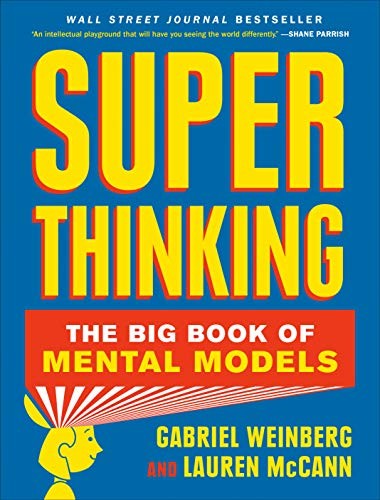
The Book in One Sentence
- Super Thinkingis about the frameworks and shortcuts top performers rely on the cut through complexity and separate good ideas from bad ones.
Favorite Quote
- “When you don’t use mental models, strategic thinking is like using addition when multiplication is available to you.”
Super Thinking Summary
1. Being Wrong Less
Carl Jacobi once said, “Invert, always invert.” What Jacobi meant by that, was thinking about a problem from an inverse perspective can unlock new solutions and strategies.
“The central mental model to help you become a chef with your thinking is arguing from first principles. It’s the practical starting point to being wrong less, and it means thinking from the bottom up, using basic building blocks of what you think is true to build sound (and sometimes new) conclusions. First principles are the group of self-evident assumptions that make up the foundation on which your conclusions rest—the ingredients in a recipe or the mathematical axioms that underpin a formula.”
“When arguing from first principles, you are deliberately starting from scratch. You are explicitly avoiding the potential trap of conventional wisdom, which could turn out to be wrong. Even if you end up in agreement with conventional wisdom, by taking the first-principles approach, you will gain a much deeper understanding of the subject at hand.”
“To be wrong less, you need to test your assumptions in the real world, a process known as de-risking. There is risk that one or more of your assumptions are untrue, and so the conclusions you reach could also be false. Once you identify the critical assumptions to de-risk, the next step is actually going out and testing these assumptions, proving or disproving them, and then adjusting your strategy appropriately.”
“Ockham’s razor advises that the simplest explanation is most likely to be true. Look at your explanation of a situation, break it down into its constituent assumptions, and for each one, ask yourself: Does this assumption really need to be here? What evidence do I have that it should remain? Is it a false dependency?”
“Overfitting occurs when you use an overly complicated explanation when a simpler one will do. It’s what happens when you don’t heed Ockham’s razor, when you get sucked into the conjunction fallacy or make a similar unforced error. It can occur in any situation where an explanation introduces unnecessary assumptions.”
“One approach to fighting overfitting is to ask yourself: How much does my data really support my conclusion versus other conclusions?”
“When crafting a solution to a problem, whether making a decision or explaining data, you want to start with the simplest set of assumptions you can think of and de-risk them as simply as possible.”
“If you’re trying to be as objective as possible when making a decision or solving a problem, you always want to account for your frame of reference. A frame-of-reference mental trap is framing. Framing refers to the way you present a situation or explanation. You will of course be influenced by your perspective, but you don’t want to be unknowingly influenced. Therefore, if you think you may not have the full understanding of a situation, then you must actively try to get it by looking from a variety of different frames of reference. When someone presents a new idea or decision to you, take a step back and consider other ways in which it could be framed.”
“A related trap/trick is nudging. You can be nudged in a direction by a subtle word choice or other environmental cues.”
Another concept you will find useful when making purchasing decisions is anchoring, which describes your tendency to rely too heavily on first impressions when making decisions.
Theavailability bias occurs when a bias, or distortion, creeps into your objective view of reality thanks to information recently made available to you. Further, the availability bias stems from overreliance on your recent experiences within your frame of reference, at the expense of the big picture.
Consequently, to be wrong less when thinking about people, you must find ways to increase your empathy, opening up a deeper understanding of what other people are really thinking.
In any conflict between two people, there are two sides of the story. Then there is the third story, the story that a third, impartial observer would recount.
“Forcing yourself to think as an impartial observer can help you in any conflict situation, including difficult business negotiations and personal disagreements.”
“If you can coherently articulate other points of view, even those directly in conflict with your own, then you will be less likely to make biased or incorrect judgments.”
“Another tactical model that can help you empathize is themost respectful interpretation, or MRI. In any situation, you can explain a person’s behavior in many ways. MRI asks you to interpret the other parties’ actions in the most respectful way possible. It’s giving people the benefit of the doubt.”
“Hanlon’s razor invites you to never attribute to malice that which is adequately explained by carelessness.”
“The third story, most respectful interpretation, and Hanlon’s razor are all attempts to overcome what psychologists call the fundamental attribution error, where you frequently make errors by attributing others’ behaviors to their internal, or fundamental, motivations rather than external factors.”
“Theveil of ignorance holds that when thinking about how society should be organized, we should do so by imagining ourselves ignorant of our particular place in the world, as if there were a veil preventing us from knowing who we are.”
“The human tendency to gather and interpret new information in a biased way to confirm preexisting beliefs is called confirmation bias.”
“Confirmation bias is so hard to overcome that there is a related model called the backfire effect that describes the phenomenon of digging in further on a position when faced with clear evidence that disproves it. In other words, it often backfires when people try to change your mind with facts and figures, having the opposite effect on you than it should; you become more entrenched in the original, incorrect position, not less.”
“You may also succumb to holding on to incorrect beliefs because of disconfirmation bias, where you impose a stronger burden of proof on the ideas you don’t want to believe.”
“The pernicious effects of confirmation bias and related models can be explained by cognitive dissonance, the stress felt by holding two contradictory, dissonant, beliefs at once.”
“A real trick to being wrong less is to fight your instincts to dismiss new information and instead to embrace new ways of thinking and new paradigms.”
“There are a couple of tactical mental models that can help you on an everyday basis to overcome your ingrained confirmation bias and tribalism. First, consider thinking gray. You may think about issues in terms of black and white, but the truth is somewhere in between, a shade of gray. A truly effective leader, however, needs to be able to see the shades of gray inherent in a situation in order to make wise decisions as to how to proceed.”
“A second mental model that can help you with confirmation bias is theDevil’s advocate position. More broadly, playing the Devil’s advocate means taking up an opposing side of an argument, even if it is one you don’t agree with. One approach is to force yourself literally to write down different cases for a given decision or appoint different members in a group to do so.”
“Another, more effective approach is to proactively include people in a decision-making process who are known to hold opposing viewpoints. Doing so will help everyone involved more easily see the strength in other perspectives and force you to craft a more compelling argument in favor of what you believe.”
“Sometimes you may want something to be true so badly that you fool yourself into thinking it is likely to be true. This feeling is known as optimistic probability bias, because you are too optimistic about the probability of success.”
Key Takeaways
- To avoid mental traps, you must think more objectively. Try arguing from first principles, getting to root causes, and seeking out the third story.
- Realize that your intuitive interpretations of the world can often be wrong due to availability bias, fundamental attribution error, optimistic probability bias, and other related mental models that explain common errors in thinking.
- Use Ockham’s razor and Hanlon’s razor to begin investigating the simplest objective explanations. Then test your theories by de-risking your assumptions, avoiding premature optimization.
- Attempt to think gray in an effort to consistently avoid confirmation bias.
- Actively seek out other perspectives by including the Devil’s advocate position and bypassing the filter bubble. Consider the adage “You are what you eat.” You need to take in a variety of foods to be a healthy person. Likewise, taking in a variety of perspectives will help you become a super thinker.
2. Anything That Can Go Wrong, Will
Key Takeaways
- “In any situation where you can spot spillover effects (like a polluting factory), look for an externality (like bad health effects) lurking nearby. Fixing it will require intervention either by fiat (like government regulation) or by setting up a marketplace system according to the Coase theorem (like cap and trade).”
- “Public goods (like education) are particularly susceptible to the tragedy of the commons (like poor schools) via the free rider problem (like not paying taxes).”
- “Beware of situations with asymmetric information, as they can lead to principal-agent problems.”
- “Be careful when basing rewards on measurable incentives, because you are likely to cause unintended and undesirable behavior (Goodhart’s law).”
- “Short-termism can easily lead to the accumulation of technical debt and create disadvantageous path dependence; to counteract it, think about preserving optionality and keep in mind the precautionary principle.”
- “Internalize the distinction between irreversible and reversible decisions, and don’t let yourself succumb to analysis paralysis for the latter.”
- “Heed Murphy’s law!”
3. Spend Your Time Wisely
Key Takeaways
- “Choose activities to work on based on their relevance to your north star.”
- “Focus your time on just one of these truly important activities at a time (no multitasking!), making it the top idea on your mind.”
- “Select between options based on opportunity cost models.”
- “Use the Pareto principle to find the 80/20 in any activity and increase your leverage at every turn.”
- “Recognize when you’ve hit diminishing returns and avoid negative returns.”
- “Use commitment and the default effect to avoid present bias, and periodic evaluations to avoid loss aversion and the sunk-cost fallacy.”
- “Look for shortcuts via existing design patterns, tools, or clever algorithms. Consider whether you can reframe the problem.”
4. Becoming One with Nature
Key Takeaways
- “Adopt an experimental mindset, looking for opportunities to run experiments and apply the scientific method wherever possible.”
- “Respect inertia: create or join healthy flywheels; avoid strategy taxes and trying to enact change in high-inertia situations unless you have a tactical advantage such as discovery of a catalyst and a lot of potential energy.”
- “When enacting change, think deeply about how to reach critical mass and how you will navigate the technology adoption life cycle.”
- “Use forcing functions to grease the wheels for change.”
- “Actively cultivate your luck surface area and put in work needed to not be subsumed by entropy.”
- “When faced with what appears to be a zero-sum or black-and-white situation, look for additional options and ultimately for a win-win.”
5. Lies, Damned Lies, and Statistics
Key Takeaways
- “Avoid succumbing to the gambler’s fallacy or the base rate fallacy.”
- “Anecdotal evidence and correlations you see in data are good hypothesis generators, but correlation does not imply causation—you still need to rely on well-designed experiments to draw strong conclusions.”
- “Look for tried-and-true experimental designs, such as randomized controlled experiments or A/B testing, that show statistical significance.”
- “The normal distribution is particularly useful in experimental analysis due to the central limit theorem. Recall that in a normal distribution, about 68 percent of values fall within one standard deviation, and 95 percent within two.”
- “Any isolated experiment can result in a false positive or a false negative and can also be biased by myriad factors, most commonly selection bias, response bias, and survivorship bias.”
- “Replication increases confidence in results, so start by looking for a systematic review and/or meta-analysis when researching an area.”
- “Always keep in mind that when dealing with uncertainty, the values you see reported or calculate yourself are uncertain themselves, and that you should seek out and report values with error bars!”
6. Decisions, Decisions
Key Takeaways
- “When tempted to use a pro-con list, consider upgrading to a cost-benefit analysis or decision tree as appropriate.”
- “When making any quantitative assessment, run a sensitivity analysis across inputs to uncover key drivers and appreciate where you may need to seek greater accuracy in your assumptions. Pay close attention to any discount rate used.”
- “Beware of black swan events and unknown unknowns. Use systems thinking and scenario analysis to more systematically uncover them and assess their impact.”
- “For really complex systems or decision spaces, consider simulations to help you better assess what may happen under different scenarios.”
- “Watch out for blind spots that arise from groupthink. Consider divergent and lateral thinking techniques when working with groups, including seeking more diverse points of view.”
- “Strive to understand the global optimum in any system and look for decisions that move you closer to it.”
7. Dealing with Conflict
Key Takeaways
- “Analyze conflict situations through a game-theory lens. Look to see if your situation is analogous to common situations like the prisoner’s dilemma, ultimatum game, or war of attrition.”
- “Consider how you can convince others to join your side by being more persuasive through the use of influence models like reciprocity, commitment, liking, social proof, scarcity, and authority. And watch out for how they are being used on you, especially through dark patterns.”
- “Think about how a situation is being framed and whether there is a way to frame it that better communicates your point of view, such as social norms versus market norms, distributive justice versus procedural justice, or an appeal to emotion.”
- “Try to avoid direct conflict because it can have uncertain consequences. Remember there are often alternatives that can lead to more productive outcomes. If diplomacy fails, consider deterrence and containment strategies.”
- “If a conflict situation is not in your favor, try to change the game, possibly using guerrilla warfare and punching-above-your-weight tactics.”
- “Be aware of how generals always fight the last war, and know your best exit strategy.”
8. Unlocking People’s Potential
Bill Bradley once said, “Leadership is unlocking people’s potential to become better.”
It’s sometimes said, “Culture is what happens when managers aren’t in the room.”
Key Takeaways
- “People are not interchangeable. They come from a variety of backgrounds and with a varied set of personalities, strengths, and goals. To be the best manager, you must manage the person, accounting for each individual’s unique set of characteristics and current challenges.”
- “Craft unique roles that amplify each individual’s strengths and motivations. Avoid the Peter principle by promoting people only to roles in which they can succeed.”
- “Properly delineate roles and responsibilities using the model of DRI (directly responsible individual).”
- “People need coaching to reach their full potential, especially at new roles. Deliberate practice is the most effective way to help people scale new learning curves. Use the consequence-conviction matrix to look for learning opportunities, and use radical candor within one-on-ones to deliver constructive feedback.”
- “When trying new things, watch out for common psychological failure modes like impostor syndrome and the Dunning-Kruger effect.”
- “Actively define group culture and consistently engage in winning hearts and minds toward your desired culture and associated vision.”
- “If you can set people up for success in the right roles and well-defined culture, then you can create the environment for 10x teams to emerge.”
9. Flex Your Market Power
Charlie Munger once said, “Mimicking the herd invites regression to the mean.”
Key Takeaways
- “Find a secret and build your career or organization around it, searching via customer development for product/market fit (or another “fit” relevant to the situation).”
- “Strive to be like a heat-seeking missile in your search for product/market fit, deftly navigating the idea maze. Look for signs of hitting a resonant frequency for validation.”
- “If you can’t find any bright spots in what you’re doing after some time, critically evaluate your position and consider a pivot.”
- “Build a moat around yourself and your organization to create sustainable competitive advantage.”
- “Don’t get complacent; remember only the paranoid survive, and keep on the lookout for disruptive innovations, particularly those with a high probability of crossing the chasm.”
Books Mentioned
- Accidental EmpiresRobert X. Cringely
- Crossing the Chasmby Geoffrey A Moore
- Good to Greatby Jim Collins
- Influence: The Psychology of Persuasionby Robert B. Cialdini
- Invisible Armiesby Max Boot
- Mindset: The New Psychology of Successby Carol Dweck
- Moneyballby Michael Lewis
- Obedience to Authorityby Stanley Milgram
- Predictably Irrationalby Dan Ariely
- Radical Candorby Kim Scott
- Superforecastingby Philip E. Tetlock and Dan Gardner
- The Believing Brainby Michael Shermer
- The Better Angels of Our Natureby Steven Pinker
- The Big Shortby Michael Lewis
- The Contrarian’s Guide to Leadershipby Steven B. Sample and Warren Bennis
- The Demon-Haunted Worldby Carl Sagan and Ann Druyan
- The Innovator’s Dilemmaby Clayton M. Christensen
- The Paradox of Choiceby Barry Schwartz
- The Wisdom of Crowdsby James Surowiecki
- Warren Buffet Speaksby Janet Lowe, Sean Pratt, et al.
- What Do You Care What Other People Think?by Richard P. Feynman and Ralph Leighton
Recommended Reading
If you likeSuper Thinking, you might also like:
- Decisive: How to Make Better Decisionsby Chip & Dan Heath
- Indistractable: How to Control Your Attention and Choose Your Lifeby Nir Eyal
- Digital Minimalism: Choosing a Focused Life in a Noisy Worldby Cal Newport
Buy The Book: Super Thinking
Related Lists
- Business Book Summaries
- Psychology Book Summaries
- Self-Help Book Summaries
Or,browse more book summaries.
Back to All Book Summaries