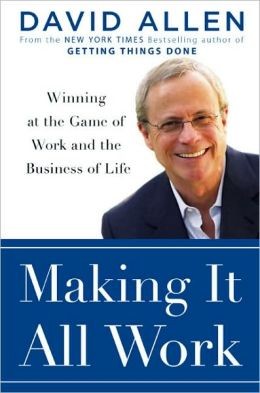
The Book in One Sentence
- A good, albeit long, read on gaining control of and perspective on all aspects of “work.”
Making It All Work Summary
“You can’t really manage time; time just is. What you can manage is yourself— your focus and your actions.”
In Allen’s experience, people who have embraced the GTD model seem to fall into three basic categories:
- Those who think they got it but didn’t really get it.
- Those who got some of it and realize they didn’t really apply it as they should.
- Those who really got it, and really implemented it to an “advanced” level.
The Five Steps of GTD are as follows:
- Capturing anything and everything that has your attention;
- Defining actionable things discretely into outcomes and concrete next steps
- Organizing reminders and information in the most streamlined way, in appropriate categories, based on how and when you need to access them; and
- Keeping current and “on your game” with appropriately frequent reviews of the six horizons of your commitments (purpose, vision, goals, areas of focus, projects, and actions)
“The art of mastering workflow, by collecting, processing, organizing, reviewing, and doing, provides the component of control. The Natural Planning Model and the Horizons of Focus both supply perspective.”
“Control without perspective is micromanagement, and perspective without control is crazy-making.”
Loss of control and perspective is the natural price you pay for being creative and productive. The trick is not how to prevent this from happening, but how to shorten the time you stay in an unsettled state.
Allen defies work as anything you want to get done that’s not done yet.
“If you don’t pay attention to what has your attention, it will take more of your attention than it deserves.”
To briefly summarize GTD, decide whether something is actionable or not, and then determine the outcomes and actions required for those things you’ve committed to move on; for those that don’t have an action tied to them, decide what’s trash, what’s to be reviewed later, and what’s to be classified as reference.
When anything grabs your attention, ask yourself:
- What’s my desired outcome? What am I committed to accomplishing or finishing about this?
- What’s the next action? What’s the next thing I need to do to move toward that goal?
A good 10 percent of Allen’s own active projects start with “R & D,” which is his shorthand for “Look into.”
“Being organized simply means that where things are suits what they mean to you.”
The best criteria to determine whether or not you’ve actually thought something through sufficiently to act upon it is how clearly you can answer these three questions:
- What has to happen first?
- What does doing look like?
- Where does it happen?
Once you reach twenty thousand feet—that is, horizon 2, Areas of Focus—the relevant question you need to ask yourself is: What do I need to maintain? Categories here include your relationships, your household, parenting, finances, self-expression, career, service, and health.
One easy way to identify your own relevant categories at the Areas of Focus level for yourself is to examine your projects and your actions and ask yourself,“Why am I doing that? What area of interest or responsibility does it reflect?”
What do I want to achieve? This is the fundamental question at the Goals level, the next horizon upward, which incorporates the commitments you may have to complete or goals you’re eager to accomplish over the next year or two.
The question that frames Vision is:
- What would long-term success look, sound, and feel like? Or, put another way, What are your long-term goals—goals that stretch out further than two years?
- A more dynamic approach would be to ask: If you were wildly successful in the coming years, what do you imagine or see yourself doing or being?
Sometimes the straightforward question,“So what do you see yourself doing five years from now?”is enough to elicit a stream of creative thinking and goal clarification. At other times it is best to simply ask,“What is the biggest and best thing you can imagine for yourself (or your organization)?”
Purpose provides the ultimate intentionality for existence and direction; principles represent the core values to be maintained en route. Purpose can also refer to the ultimate goal—of a project, an action, or any endeavor, but, ultimately, Purpose, in its deepest sense, refers to the essence of something—its reason for being.
On an individual basis, an equivalent personal statement of purpose would represent the highest criterion for direction and meaning.“I exist as a human being to …”
In Allen’s experience, there are three ways to be involved with each altitude, and the more comfortable and familiar you are with each, the more capable you’ll be of using the horizons as a practical and effective road map:
- Identifying and clarifying your current commitments
- Reviewing and reminding yourself about the commitments
- Changing the commitments.
Recommended Reading
If you likeMaking It All Work, you might also like:
- Getting Things Done: The Art of Stress-Free Productivityby David Allen
- Deep Work: Rules for Focused Success in a Distracted Worldby Cal Newport
- Essentialism: The Disciplined Pursuit of Lessby Greg McKeown
Buy The Book: Making It All Work
Hardcover|Kindle|Audiobook
Related Lists
- Business Book Summaries
- Psychology Book Summaries
- Self-Help Book Summaries
Or,browse more book summaries.
Back to All Book Summaries