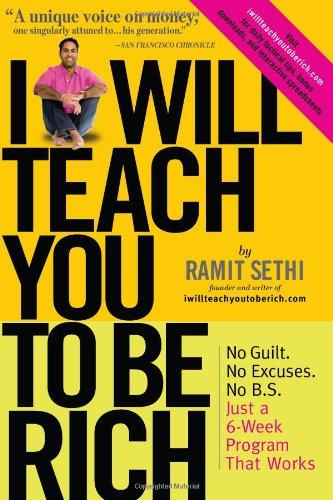
The Book in One Sentence
- I Will Teach You to Be Richis about how to earn more, save more, and live a Rich Life.
The Five Big Ideas
- You don’t need to be an expert to get rich…
- …but you do need to get started early.
- Spend extravagantly on the things you love and cut costs mercilessly on the things you don’t.
- Use money to design your Rich Life.
- There’s a limit to how much you can cut, but no limit to how much you can earn.
I Will Teach You to Be Rich Summary
Invisible scripts are the messages you’ve absorbed from your parents and society that guide your decisions—often without your knowledge.
For example,
- “You’re throwing money away on rent.”
- “Credit cards are a scam.”
- “Money changes people.”
Editor’s Note
While popularized by Sethi, the term “invisible scripts” was coined by Dr. Brad Klontz. You can learn more about him here
“Most of us fall into one of two camps regarding money: We either ignore it and feel guilty, or we obsess over financial details by arguing interest rates and geopolitical risks without taking action. Both options yield the same results—none.”
“People love arguing minor points, partially because they feel it absolves them from actually having to do anything.”
“You don’t need to be an expert to get rich.”
“The single most important thing you can do to be rich is to start early.”
“In relationships and work, we want to better than average. In investing, average is great.”
The key messages ofI Will Teach You to Be Richare:
- Getting started is more important than becoming an expert (also known as “The 85 Percent Solution”);
- Understanding that it’s okay to make mistakes;
- Spending extravagantly on the things you love and cutting costs mercilessly on the things you don’t (also known as “conscious spending”);
- Realizing there’s a difference between being sexy and being rich;
- Not living in the spreadsheet;
- Playing offense, not defense; and
- Using money to design your Rich Life.
Sethi considers himself rich now because he can:
- Make career decisions because he wants to, not because of money;
- Help his parents with their retirement, so they don’t have to work if they don’t want to; and
- Spend extravagantly on the things he loves and be relentlessly frugal about the things he doesn’t.
What Is a Rich Life?
A Rich Life means you can spend on the things you love as long as you cut costs mercilessly on the things you don’t.
A Rich Life means you can spend on the things you love as long as you cut costs mercilessly on the things you don’t.
“Focus on the Big Wins—the five to ten things that get you disproportionate results, including automating your savings and investing, finding a job you love, and negotiating your salary. Get the Big Wins right and you can order as many lattes as you want.”
“Investing should be very boring—and profitable—over the long term.”
“There’s a limit to how much you can cut, but no limit to how much you can earn.”
Build a collection of “spending frameworks” to use when deciding on buying something. For example, Ramit’s book-buying rule. (See below.)
“Sometimes the most advanced thing you can do is the basics, consistently.”
Having a good credit score is important because it makes you less risky to lenders, meaning they can offer you a better interest rate on loans.
“If you’re booking travel or eating out, use a travel card to maximize rewards. For everything else, use a cash back card.”
The Six Commandments of Credit Cards are,
- Pay off your credit card regularly;
- Try to get fees on your cards waived;
- Negotiate a lower APR;
- Keep your main cards for a long time, and keep them active—but also keep them simple;
- Get more credit if you’re debt-free; and
- Use your credit card’s secret perks.
When optimizing your credit cards, avoid,
- Closing accounts before thinking ahead;
- Damaging your credit score; and
- Playing the zero percent transfer game.
Sethi recommends putting at least $50 more each month toward any debt you have so you can invest sooner.
The five steps to getting rid of credit card debt are:
- Figure how much debt you have;
- Decide what to pay off first;
- Negotiate down the APR;
- Decide where the money to pay off your credit card will come from; and
- Get started.
Your savings account is where you deposit money; your checking account is where you withdraw money.
When choosing a bank, look for trust, convenience and features.
Sethis recommends Charles Schwab and Capital One as banks to consider and Bank of America and Wells Fargo as banks to avoid.
There are six systematic steps to investing. Sethi calls it “The Ladder of Personal Finance.” The “rungs” are as follows:
- Rung 1:If your employer offers a 401(k) match, invest to take full advantage of it and contribute just enough to get 100 percent of the match.
- Rung 2:Pay off your credit card and any other debt.
- Rung 3:Open up a Roth IRA and contribute as much money as possible to it.
- Rung 4:If you have money left over, go back to your 401(k) and contribute as much as possible to it.
- Rung 5:If you have access to a Health Savings Account (HSA), it can also double as an investment account with incredible tax features few people know about.
- Rung 6:If you still have money left to invest, open a regular non-retirement (“taxable”) investment account and put as much as possible there.
A Conscious Spending Plan involves four major buckets where your money will go:
- Fixed costs (50-60% of take-home pay)
- Investments (10%)
- Savings goals (5-10%)
- Guilt-free spending money (20-35%)
To optimize your spendings, do an 80/20 analysis. Oftentimes, 80 percent of what you overspend is used toward only 20 percent of your expenditures. Then, focus on one or two big problem areas and solve those instead of trying to cut 5 percent out of a bunch of smaller areas.
Sethi recommends the envelope system to target your big wins. First, decide how much you want to spend in major categories each month. Then, put money in each envelope (category). You can transfer from one envelope to another, but when the envelopes are empty, that’s it for the month.
“If you’re investing in the long-term, the best time to make money is when everyone else is getting out of the market.”
“A major predictor of your portfolio’s volatility doesn’t stem from the individual stocks you pick, as most people think, but instead from your mix of stocks and bonds.”
“Asset allocation is your plan for investing, the way you distribute the investments in your portfolio between stocks, bonds, and cash.”
“By diversifying your investments across different asset classes (like stocks and bonds, or, better yet, stock funds and bond funds), you can control the risk in your portfolio.”
“Your investment plan is more important than your actual investments.”
“It is important to diversify within stocks, but it’s even more important to allocate across the different asset classes—like stocks and bonds.”
“Diversification is D for going deep into a category (for example, buying different types of stocks: large-cap, small-cap, international, and so on), and asset allocation is A for going across all categories (for example, stocks and bonds).”
If you’re in your sixties or older, a sizable portion of your portfolio should be in stable bonds.
In your thirties or older, you’ll want to begin balancing your portfolio with bonds to reduce risk.
Sethi recommends target funds highly because they’re easy, low cost and they work.
To figure out how long it will take to double your money, divide the number 72 by the return rate you’re getting, and you’ll have the number of years you must invest in order to double your money.
If you’re picking your own index funds to build your portfolio, you will need to rebalance your portfolio once a year. Doing so will make sure your assets remain properly allocated and protect you from being vulnerable to a specific sector’s ups and down.
“Dollar-cost averaging” refers to investing regular amounts over time. Vanguard research found that “lump-sum investing”—investing a big pile of money—actually beats dollar-cost averaging two-thirds of the time.
Sethi doesn’t recommend investing in crypto-currencies unless you have a fully functioning portfolio first, meaning:
- You’ve completed the Ladder of Investing;
- You have six months of emergency funds; and
- You have limited your exposure by periodically rebalancing. (Note: the latter is irrelevant if you’re investing in a target date fund; it rebalances automatically.)
A house’s total price shouldn’t be more than three times your gross annual income.
Editor’s Note
View this post on InstagramA post shared by Ramit Sethi (@ram it)onMay 13, 2019 at 9:09am PDT
A post shared by Ramit Sethi (@ram it)onMay 13, 2019 at 9:09am PDT
Other Resources
While not included in the book, I recommend reading Ramit’s article on “Money Dials” to learn more about how to optimize your spending. You can read the article here.
Recommended Reading
If you likeI Will Teach You to Be Rich, you might also like:
- Essentialism: The Disciplined Pursuit of Lessby Greg McKeown
- Mindset: The New Psychology of Successby Carol Dweck
- Rich Dad Poor Dad: What the Rich Teach Their Kids About Money That the Poor and Middle Class Do Not!by Robert T. Kiyosaki
Buy The Book: I Will Teach You to Be Rich
Related Lists
- Business Book Summaries
- Psychology Book Summaries
- Self-Help Book Summaries
Or,browse more book summaries.
Back to All Book Summaries