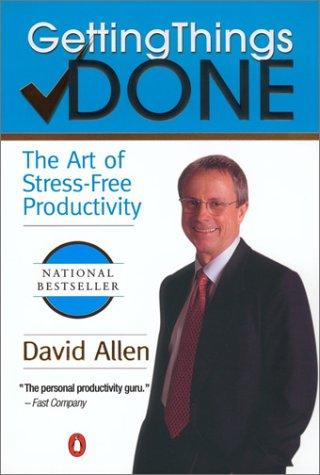
The Book in Three Sentences
- If we don’t appropriately manage the ‘open loops’ in our life, our attention will get pulled.
- Overwhelm comes from not clarifying what your intended outcome is, not deciding what the very next action is, and not reminding yourself of your intended outcome and action.
- You need to transform all the ‘stuff’ you attract and accumulate into a clear inventory of meaningful actions, projects, and usable information.
The Five Big Ideas
- Getting things done requires defining what “done” means and what “doing” looks like.
- Mastering your workflow involves capturing what has your attention, clarifying what it means, putting it where it belongs, reviewing it frequently, and engaging with it.
- If an action will take less than two minutes, it should be done at the moment it is defined.
- Anxiety and guilt don’t come from having too much to do; it comes from breaking agreements with yourself.
- Your mind is for having ideas, not for holding them.
Getting Things Done Summary
- A basic truism Allen has discovered over decades of coaching and training thousands of people is that most stress people experience comes from inappropriately managed commitments they make or accept
- “Anything that does not belong where it is, the way it is, is an ‘open loop,’ which will be pulling on your attention if it’s not appropriately managed.”
- “You must use your mind to get things off your mind.”
- “Most often, the reason something is on your mind is that you want it to be different than it currently is, and yet: you haven’t clarified exactly what the intended outcome is; you haven’t decided what the very next physical action step is; and/or you haven’t put reminders of the outcome and the action required in a system you trust.”
- Until your thoughts have been clarified and decisions have been made, and the resulting data has been stored in a system that you absolutely know you will access and think about when you need to, your brain can’t give up the job.
- “It’s a waste of time and energy to keep thinking about something that you make no progress on.”
- We need to transform all the ‘stuff’ we attract and accumulate into a clear inventory of meaningful actions, projects, and usable information.
Getting things done requires two basic components:
- Outcome. Defining what “done” means
- Action. What “doing” looks like
You need to control commitments, projects, and actions in two ways:
- Horizontally. Maintaining coherence across all the activities in which you are involved
- Vertically. Managing thinking, development, and coordination of individual topics and projects.
- “The goal for managing horizontally and vertically is the same: to get things off your mind and get them done.”
- “There is usually an inverse relationship between how much something is on your mind and how much it’s getting done.”
- “There is no reason to ever have the same thought twice unless you like having that thought.”
The Five Steps of Mastering Workflow
- Capture. Collect what has your attention
- Clarify. Process what it means
- Organize. Put it where it belongs
- Reflect. Review frequently
- Engage. Simply do.
The Three Requirements to Make the Capturing Phase Work
- Every open loop must be in your capture system and out of your head
- You must have as few capturing buckets as you can get by with
- You must empty them regularly
Getting Things Done Workflow Chart
When you’re processing an item, ask yourself, “What is it?” and, “Is it actionable?”
If it is not actionable, there are three possibilities:
- Trash. It’s no longer needed.
- Incubate. No action is needed now, but something might need to be done later.
- Reference. The item is potentially useful information that might be needed for something later.
If it is actionable, you have three options:
- Do it. If an action will take less than two minutes, it should be done at the moment it is defined.
- Delegate it. If the action will take longer than two minutes, ask yourself, “Am I the right person to do this?” If the answer is no, delegate it to the appropriate entity.
- Defer it. If the action will take longer than two minutes, and you are the right person to do it, you will have to defer acting on it until later and track it on one or more “Next Actions” lists.
- “Being organized means simply that where something is matches what it means to you.”
- Allen defines a project as any desired result that can be accomplished within a year that requires more than one action step.
Reminders of actions you need to take fall into two categories:
- Those about things that have to happen on a specific day or time
- Those about things that just need to get done as soon as possible.
There are three things go on your calendar:
- Time-specific actions. This is a fancy name for appointments.
- Day-specific actions. These are things that you need to do sometimes on a certain day, but not necessarily at a specific time.
- Day-specific information. The calendar is also the place to keep track of things you want to know about on specific days—not necessarily actions you’ll have to take but rather information that may be useful on a certain date.
- “It’s useful to have a calendar on which you can note both time-specific and day-specific actions.”
- “Next Actions lists, which, along with the calendar, are at the heart of daily action-management organization and orientation.”
No-action systems fall into three categories:
- Trash. This is self-evident.
- Incubation. These are things that require no immediate action but are worth keeping. There are two kinds of incubation tools (i) Someday/Maybe lists and (ii) a tickler system. Someday/Maybe items are of the nature of “projects I might want to do, but not now … but I’d like to be reminded of them regularly.” A tickler system is for items that you don’t want or need to be reminded of until some designated time in the future.
- Reference. Reference systems generally take two forms: (1) topic- and area-specific storage, and (2) general reference files. The first types usually define themselves in terms of how they are stored. The second type of reference system is one that everyone needs close at hand for storing ad hoc information that doesn’t belong in some predesigned larger category.
- “All of your Projects, active project plans, and Next Actions, Agendas, Waiting For, and even Someday/Maybe lists should be reviewed once a week.”
The Weekly Review is the time to:
- Gather and process all your stuff
- Review your system
- Update your lists
- Get clean, clear, current, and complete.
The Four-Criteria Model for Choosing Actions in the Moment
- Context
- Time Available
- Energy Available
- Priority
The Threefold Model for Identifying Daily Work
When you’re getting things done, or “working” in the universal sense, there are three different kinds of activities you can be engaged in:
- Doing predefined work. When you’re doing predefined work, you’re working from your Next Actions lists and calendar—completing tasks that you have previously determined need to be done, or managing your workflow.
- Doing work as it shows up. Every day brings surprises and you’ll need to expend some time and energy on many of them. However, when you follow these leads, you’re deciding by default that these things are more important than anything else you have to do at those times.
- Defining your work. Defining your work entails clearing up your in-tray, your digital messages, and your meeting notes, and breaking down new projects into actionable steps.
The Six-Level Model for Reviewing Your Own Work
- Horizon 5:Purpose and principles
- Horizon 4:Vision
- Horizon 3:Goals
- Horizon 2: Areas of focus and accountabilities
- Horizon 1:Current projects
- Ground: Current Actions. This is the accumulated list of all the actions you need to take.
- Horizon 1: Current Projects. These are the relatively short-term outcomes you want to achieve (e.g. organizing a sales conference).
- Horizon 2: Areas of Focus and Accountabilities. These are the key areas of your life and work within which you want to achieve results and maintain standards.
- Horizon 3: Goals. These are thing you’d like to accomplish or have in place, which could add importance to certain aspects of your life and diminish others.
- Horizon 4: Vision. What do you what your life and work to look like in three to five years? Decisions at this altitude can easily change what your work might look like on many levels.
- Horizon 5: Purpose and Principles. This is the big-picture view.
The key ingredients of relaxed control are:
- Clearly defined outcomes (projects) and the next actions required to move them toward closure
- Reminders placed in a trusted system that is reviewed regularly.
- “If you’re waiting to have a good idea before you have any ideas, you won’t have many.”
- “Often the only way to make a hard decision is to come back to the purpose of what you’re doing.”
- “If you’re not sure why you’re doing something, you can never do enough of it.”
- “One of the most powerful life skills and one of the most important to hone and develop for both professional and personal success is creating clear outcomes.”
- “If a project is still on your mind, there’s more thinking required.”
- “The big secret to efficient creative and productive thinking and action is to put the right things in your focus at the right time.”
- “One of the best tricks for enhancing your productivity is having organizing tools you love to use.”
- “Until you’ve captured everything that has your attention, some part of you will still not totally trust that you’re working with the whole picture of your world.”
- “You can only feel good about what you’re not doing when you know everything you’re not doing.”
Here are the four categories of things that can remain where they are, the way they are, with no action tied to them:
- Supplies
- Reference Material
- Decoration
- Equipment
Processing Guidelines
- Process the top item first
- Process one item at a time
- Never put anything back into “in.”
The in-tray is a processing station, not a storage bin. There will be three types of item in it:
- Trash
- Items to incubate
- Reference material
- “It’s fine to decide not to decide about something. You just need a decide-not-to-decide system to get it off your mind.”
There are seven primary types of things that you’ll want to keep track of and manage from an organizational and operational perspective:
- A Projects list
- Project support material
- Calendar actions and information
- Next Actions lists
- A Waiting For list
- Reference material
- A Someday/Maybe list
- “The primary reason for organizing is to reduce cognitive load—i.e. to eliminate the need to constantly be thinking, ‘What do I need to do about this?’”
- “Checklists can be highly useful to let you know what you don’t need to be concerned about.”
Allen on The Weekly Review:
[It] is whatever you need to do to get your head empty again and get oriented for the next couple of weeks. It’s going through the steps of workflow management—capturing, clarifying, organizing, and reviewing all your outstanding commitments, intentions, and inclinations—until you can honestly say, “I absolutely know right now everything I’m not doing but could be doing if I decided to.”
[It] is whatever you need to do to get your head empty again and get oriented for the next couple of weeks. It’s going through the steps of workflow management—capturing, clarifying, organizing, and reviewing all your outstanding commitments, intentions, and inclinations—until you can honestly say, “I absolutely know right now everything I’m not doing but could be doing if I decided to.”
- “Your best thoughts about work won’t happen while you’re at work.”
- “The world itself is never overwhelmed or confused—only we are, due to how we are engaged with it.”
- Allen recommends to always keep an inventory of things that need to be done that require very little mental or creative horsepower.
- “One of the best ways to increase your energy is to close some of your loops.”
- “It is impossible to feel good about your choices unless you are clear about what your work really is.”
- “There are no interruptions—there are only mismanaged inputs.”
- “Do unexpected work as it shows up, not because it is the path of least resistance, but because it is the thing you need to do vis-à-vis all the rest.”
- “Handle what has your attention and you’ll then discover what really has your attention.”
- Allen believes the most important thing to deal with is whatever is most on your mind.
- “If you’re not totally sure what your job is, it will always feel overwhelming.”
- “When you’re not sure where you’re going or what’s really important to you, you’ll never know enough.”
There are two types of projects, however, that deserve at least some sort of planning activity:
- Those that still have your attention even after you’ve determined their next actions
- Those about which potentially useful ideas and supportive detail just show up ad hoc.
- “One of the greatest blocks to organizational (and family) productivity is the lack of someone about the need for a meeting, and with whom, to move something forward.”
- “The sense of anxiety and guilt doesn’t come from having too much to do; it’s the automatic result of breaking agreements with yourself.”
- “Negative feelings are simply the result of breaking those agreements—they’re the symptoms of disintegrated self-trust.”
- “Maintaining an objective and complete inventory of your work, regularly reviewed, makes it much easier to say no with integrity.”
- “When a culture adopts ‘What’s the next action?’ as a standard operating query, there’s an increase in energy, productivity, clarity, and focus.”
- “Defining what real doing looks like on the most basic level and organizing placeholder reminders that we can trust are master keys to productivity enhancement and creating a relaxed inner environment.”
- “Without a next action, there remains a potentially infinite gap between current reality need to do.”
- “Avoiding action decisions until the pressure of the last minute creates huge inefficiencies and unnecessary stress.”
- “Defining specific projects and next actions that address real quality-of-life issues is productivity at its best.”
- “Your mind is for having ideas, not for holding them.”
- “You can only put your conscious attention on one thing at a time.”
- “Providing yourself the right cues, which you will notice at the right time, about the right things, is a core practice of stress-free productivity.”
Recommended Reading
If you likeGetting Things Done, you may also enjoy the following books:
- 7 Habits of Highly Effective Peopleby Stephen R. Covey
- Deep Work: Rules for Focused Success in a Distracted Worldby Cal Newport
- Eat That Frog! Get More of the Important Things Done – Today!by Brian Tracy
Buy The Book: Getting Things Done
Print|Hardcover|Audiobook
Related Lists
- Business Book Summaries
- Psychology Book Summaries
- Self-Help Book Summaries
Or,browse more book summaries.
Back to All Book Summaries