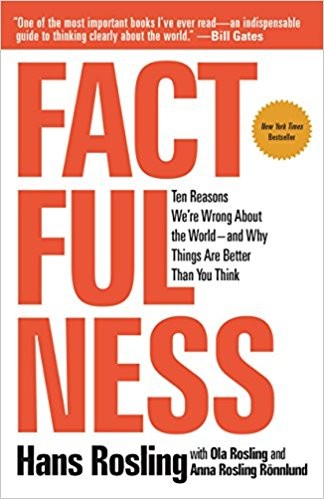
The Book in One Sentence
- Factfulnessis about the ten instincts that distort our perspective of the world and prevent us from seeing how it actually is.
Factfulness Summary
10 Instincts That Distort Our Perspective
- The Gap Instinct. Our tendency to divide things into two distinct and often conflicting groups with an imagined gap between them (e.g.us and them).
- The Negativity Instinct. Our tendency to notice the bad more than the good (e.g. believing that things are getting worse when things are actually getting better).
- The Straight Line Instinct. Our tendency to assume that a line will just continue straight and ignoring that such lines are rare in reality.
- The Fear Instinct. Our hardwired tendency to pay more attention to frightening things.
- The Size Instinct. Our tendency to get things out of proportion, or misjudge the size of things (e.g. we systematically overestimate the proportions of immigrants in our countries.)
- The Generalization Instinct. Our tendency to mistakenly group together things or people, or countries that are actually very different.
- The Destiny Instinct. The idea that innate characteristics determine the destinies of people, countries, religions, or cultures; that things are as they are because of inescapable reasons.
- The Single Perspective. Our tendency to focus on a single cause or perspective when it comes to understanding the world (e.g. forming your worldview by relying on the media, alone).
- The Blame Instinct. Our tendency to find a clear, simple reason for why something bad has happened.
- The Urgency Instinct. Our tendency to take immediate action in the face of perceived imminent danger, and in doing so, amplifying our other instincts.
Introduction: Why I Love the Circus
Every group of people that Hans Rosling asks thinks that the world is more frightening, more violent, and more hopeless than it really is.
“Step-by-step, year-by-year, the world is improving,” writes Rosling. “Not on every single measure every single year, but as a rule. Though the world faces huge challenges, we have made tremendous progress. This is the fact-based worldview.”
Rosling writes, “We need to learn to control our drama intake. Uncontrolled, our appetite for the dramatic goes too far, prevents us from seeing the world as it is, and leads us terribly astray.”
Chapter One: The Gap Instinct
The gap instinct describes our tendency to divide things into two distinct and often conflicting groups with an imagined gap in between them.
“Eighty-five percent of mankind is already inside the box that used to be named ‘developed world.’ The remaining 15 percent are mostly in between the two boxes. Only 13 countries, representing 6 percent of the world population, are still inside the ‘developing’ box.”
“There is no gap between the West and the rest, between developed and developing, between rich and poor. And we should all stop using the simple pairs of categories that suggest there is.”
“Only 9 percent of the world lives in low-income countries.”
“Low-income countries are much more developed than most people think. And vastly fewer people live in them. The idea of a divided world with a majority stuck in misery and deprivation is an illusion. A complete misconception. Simply wrong.”
“The majority of people live neither in low-income countries nor in high-income countries, but in middle-income countries. This category doesn’t exist in the divided mindset, but in reality, it definitely exists.”
“Dividing countries into two groups no longer make sense,” says Rosling. It doesn’t help us to understand the world in a practical way. Nor does it help businesses find opportunities or aid money to find the poorest people.
Our most important challenge in developing a fact-based worldview, according to Rosling, is to realize that most of our firsthand experiences are from Level 4;and that our secondhand experiences are filtered through the mass media, which loves nonrepresentative extraordinary events and shuns normality.
Factfulness Is …
- … recognizing when a story talks about a gap and remembering that this paints a picture of two separate groups, with a gap in between. The reality is often not polarized at all. Usually, the majority is right there in the middle, where the gap is supposed to be.
- To control the gap instinct, look for the majority.
- Beware comparisons of averages. If you could check the spreads you would probably find they overlap. There is probably no gap at all.
- Beware comparisons of extremes. In all groups, of countries or people, there are some at the top and some at the bottom. The difference is sometimes extremely unfair. But even then the majority is usually somewhere in between, right where the gap is supposed to be.
- The view from up here. Remember, looking down from above distorts the view. Everything else looks equally short, but it’s not.
Chapter Two: The Negativity Instinct
The negativity instinct describes our tendency to notice the bad more than the good.
Rosling invites readers to think of the world as a premature baby in an incubator. He writes,
Does it make sense to say that the infant’s situation is improving? Yes. Absolutely. Does it make sense to say it is bad? Yes, absolutely. Does saying “things are improving” imply that everything is fine, and we should all relax and not worry? No, not at all. Is it helpful to have to choose between bad and improving? Definitely not. It’s both. It’s both bad and better. Better, and bad, at the same time. That is how we must think about the current state of the world.
Does it make sense to say that the infant’s situation is improving? Yes. Absolutely. Does it make sense to say it is bad? Yes, absolutely. Does saying “things are improving” imply that everything is fine, and we should all relax and not worry? No, not at all. Is it helpful to have to choose between bad and improving? Definitely not. It’s both. It’s both bad and better. Better, and bad, at the same time. That is how we must think about the current state of the world.
When you hear about something terrible, calm yourself by asking, If there had been an equally large positive improvement, would I have heard about that?
Factfulness Is …
- … recognizing when we get negative news, and remembering that information about bad events is much more likely to reach us. When things are getting better we often don’t hear about them. This gives us a systematically too-negative impression of the world around us, which is very stressful. To control the negativity instinct, expect bad news.
- Better and bad. Practice distinguishing between a level (e.g., bad) and a direction of change (e.g., better). Convince yourself that things can be both better and bad.
- Good news is not news. Good news is almost never reported. So the news is almost always bad. When you see bad news, ask whether equally, positive news would have reached you.
- Gradual improvement is not news. When a trend is gradually improving, with periodic dips, you are more likely to notice the dips than the overall improvement.
- More news does not equal more suffering. More bad news is sometimes due to better surveillance of suffering, not a worsening world.
- Beware of rosy pasts. People often glorify their early experiences, and nations often glorify their histories.
Chapter Three: The Straight Line Instinct
The straight line instinct describes our tendency to assume that a line will just continue straight and ignoring that such lines are rare in reality.
The world population is increasing. But it’s not just increasing. The “just” implies that, if nothing is done, the population will just keep on growing. It implies that some drastic action is needed in order to stop the growth. That is the misconception, and Rosling believes that it is based on our instinct to assume that lines are straight.
Factfulness Is …
- … recognizing the assumption that a line will just continue straight, and remembering that such lines are rare in reality. To control the straight line instinct, remember that curves come in different shapes.
- Don’t assume straight lines. Many trends do not follow straight lines but are S-bends, slides, humps, or doubling lines. No child ever kept up the rate of growth it achieved in its first six months, and no parents would expect it to.
Chapter Four: The Fear Instinct
The fear instinct describes our tendency to pay more attention to frightening things.
“Critical thinking is always difficult, but it’s almost impossible when we are scared. There’s no room for facts when our minds are occupied by fear.”
“The image of a dangerous world has never been broadcast more effectively than it is now, while the world has never been less violent and more safe.”
Factfulness Is …
- … recognizing when frightening things get our attention, and remembering that these are not necessarily themost risky. Our natural fears of violence, captivity, and contamination make us systematically overestimate these risks. To control the fear instinct, calculate the risks.
- The scary world: fear vs. reality. The world seems scarier than it is because what you hear about it has been selected—by your own attention filter or by the media—precisely because it is scary.
- Risk = danger × exposure. The risk something poses to you depends not on how scared it makes you feel, but on a combination of two things. How dangerous is it? And how much are you exposed to it?
- Get calm before you carry on. When you are afraid, you see the world differently. Make as few decisions as possible until the panic has subsided.
Chapter Five: The Size Instinct
The size instinct describes our tendency to get things out of proportion, or misjudge the size of things (e.g. we systematically overestimate the proportions of immigrants in our countries.)
Ingegerd Rooth, a missionary nurse, once told Han Rosling, “In the deepest poverty, you should never do anything perfectly. If you do you are stealing resources from where they can be better used.”
“The two aspects of the size instinct, together with the negativity instinct, make us systematically underestimate the progress that has been made in the world.”
“To avoid getting things out of proportion you need only two magic tools: comparing and dividing.”
“The most important thing you can do to avoid misjudging something’s importance is to avoid lonely numbers. Never, ever leave a number all by itself. Never believe that one number on its own can be meaningful. If you are offered one number, always ask for at least one more. Something to compare it with. Be especially careful about big numbers.”
Factfulness Is …
- … recognizing when a lonely number seems impressive (small or large), and remembering that you could get the opposite impression if it were compared with or divided by some other relevant number. To control the size instinct, get things in proportion.
- Compare. Big numbers always look big. Single numbers on their own are misleading and should make you suspicious. Always look for comparisons. Ideally, divide by something.
- 80/20.Have you been given a long list? Look for the few largest items and deal with those first. They are quite likely more important than all the others put together.
- Divide. Amounts and rates can tell very different stories. Rates are more meaningful, especially when comparing between different-sized groups. In particular, look for rates per person when comparing between countries or regions.
Chapter Six: The Generalization Instinct
“[The generalization instinct] can make us mistakenly group together things, or people, or countries that are actually very different. It can make us assume everything or everyone in one category is similar. And, maybe most unfortunate of all, it can make us jump to conclusions about a whole category based on a few, or even just one, unusual example.”
Factfulness Is …
- … recognizing when a category is being used in an explanation, and remembering that categories can be misleading. We can’t stop generalization and we shouldn’t even try. What we should try to do is to avoid generalizing incorrectly. To control the generalization instinct, question your categories.
- Look for differences within groups. Especially when the groups are large, look for ways to split them into smaller, more precise categories. And …
- Look for similarities across groups. If you find striking similarities between different groups, consider whether your categories are relevant. But also …
- Look for differences across groups. Do not assume that what applies for one group (e.g., you and other people living on Level 4 or unconscious soldiers) applies for another (e.g., people not living on Level 4 or sleeping babies).
- Beware of “the majority.”The majority just means more than half. Ask whether it means 51 percent, 99 percent, or something in between.
- Beware of vivid examples. Vivid images are easier to recall but they might be the exception rather than the rule.
- Assume people are not idiots. When something looks strange, be curious and humble, and think, In what way is this a smart solution?
Chapter Seven: The Destiny Instinct
The destiny instinct is the idea that innate characteristics determine the destinies of people, countries, religions, or cultures. It’s the idea that things are as they are for ineluctable, inescapable reasons: they have always been this way and will never change.
This instinct makes us believe that our false generalizations (the generalization instinct) or the tempting gaps (the gap instinct) are not only true but fated: unchanging and unchangeable.
Factfulness Is …
- … recognizing that many things (including people, countries, religions, and cultures) appear to be constant just because the change is happening slowly, and remembering that even small, slow changes gradually add up to big changes. To control the destiny instinct, remember slow change is still change.
- Keep track of gradual improvements.A small change every year can translate to a huge change over time.
- Update your knowledge. Some knowledge goes out of date quickly. Technology, countries, societies, cultures, and religions are constantly changing.
- Talk to Grandpa. If you want to be reminded of how values have changed, think about your grandparents’ values and how they differ from yours.
- Collect examples of cultural change. Challenge the idea that today’s culture must also have been yesterday’s, and will also be tomorrow’s.
Chapter Eight: The Single Perspective Instinct
“Being always in favor of or always against any particular idea makes you blind to information that doesn’t fit your perspective. This is usually a bad approach if you like to understand reality. Instead, constantly test your favorite ideas for weaknesses. Be humble about the extent of your expertise. Be curious about new information that doesn’t fit, and information from other fields. And rather than talking only to people who agree with you, or collecting examples that fit your ideas, see people who contradict you, disagree with you, and put forward different ideas as a great resource for understanding the world.”
Factfulness Is …
- … recognizing that a single perspective can limit your imagination, and remembering that it is better to look at problems from many angles to get a more accurate understanding and find practical solutions. To control the single perspective instinct, get a toolbox, not a hammer.
- Test your ideas. Don’t only collect examples that show how excellent your favorite ideas are. Have people who disagree with you test your ideas and find their weaknesses.
- Limited expertise. Don’t claim expertise beyond your field: be humble about what you don’t know. Be aware too of the limits of the expertise of others.
- Hammers and nails. If you are good with a tool, you may want to use it too often. If you have analyzed a problem in depth, you can end up exaggerating the importance of that problem or of your solution. Remember that no one tool is good for everything. If your favorite idea is a hammer, look for colleagues with screwdrivers, wrenches, and tape measures. Be open to ideas from other fields.
- Numbers, but not only numbers. The world cannot be understood without numbers, and it cannot be understood with numbers alone. Love numbers for what they tell you about real lives.
- Beware of simple ideas and simple solutions. History is full of visionaries who used simple utopian visions to justify terrible actions. Welcome complexity. Combine ideas. Compromise. Solve problems on a case-by-case basis.
Chapter Nine: The Blame Instinct
The blame instinct describes our tendency to find a clear, simple reason for why something bad has happened.
When things go wrong, it’s easy to assume it’s due to bad people with bad intentions.
Rosling writes, “We like to believe that things happen because someone wanted them to, that individuals have power and agency: otherwise, the world feels unpredictable, confusing, and frightening.”
“The blame instinct makes us exaggerate the importance of individuals or of particular groups,” writes Rosling. “This instinct to find a guilty party derails our ability to develop a true, fact-based understanding of the world: it steals our focus as we obsess about someone to blame, then blocks our learning because once we have decided who to [blame] we stop looking for explanations elsewhere. This undermines our ability to solve the problem or prevent it from happening again because we are stuck with over simplistic finger-pointing, which distracts us from the more complex truth and prevents us from focusing our energy in the right places.
Factfulness Is …
- … recognizing when a scapegoat is being used and remembering that blaming an individual often steals the focus from other possible explanations and blocks our ability to prevent similar problems in the future. To control the blame instinct, resist finding a scapegoat.
- Look for causes, not villains. When something goes wrong don’t look for an individual or a group to blame. Accept that bad things can happen without anyone intending them to. Instead spend your energy on understanding the multiple interacting causes, or system, that created the situation.
- Look for systems, not heroes. When someone claims to have caused something good, ask whether the outcome might have happened anyway, even if that individual had done nothing. Give the system some credit.
Chapter Ten: The Urgency Instinct
The urgency instinct describes our tendency to take immediate action in the face of perceived imminent danger, and in doing so, amplifying our other instincts.
To paraphrase Rosling, the urgency instinct served us well in the past. For example, if we thought there might be a lion in the grass, it wasn’t sensible to do too much analysis. But now that we have eliminated most immediate dangers and are left with more complex and often more abstract problems, the urgency instinct can lead us astray when it comes to our understanding of the world around us.
Factfulness Is …
- … recognizing when a decision feels urgent and remembering that it rarely is. To control the urgency instinct, take small steps.
- Take a breath. When your urgency instinct is triggered, your other instincts kick in and your analysis shuts down. Ask for more time and more information. It’s rarely now or never and it’s rarely either/or.
- Insist on the data. If something is urgent and important, it should be measured. Beware of data that is relevant but inaccurate, or accurate but irrelevant. Only relevant and accurate data is useful.
- Beware of fortune-tellers. Any prediction about the future is uncertain. Be wary of predictions that fail to acknowledge that. Insist on a full range of scenarios, never just the best or worst case. Ask how often such predictions have been right before.
- Be wary of drastic action. Ask what the side effects will be. Ask how the idea has been tested. Step-by-step practical improvements and evaluation of their impact are less dramatic but usually more effective.
Recommended Reading
If you likeFactfulness, you might also like:
- Atomic Habits: Tiny Changes, Remarkable Resultsby James Clear
- Never Split the Difference: Negotiating As If Your Life Depends On Itby Chris Voss
- Predictably Irrationalby Dan Ariely
Buy The Book: Factfulness
Print|Hardcover|Audiobook
Related Lists
- Business Book Summaries
- Psychology Book Summaries
- Self-Help Book Summaries
Or,browse more book summaries.
Back to All Book Summaries