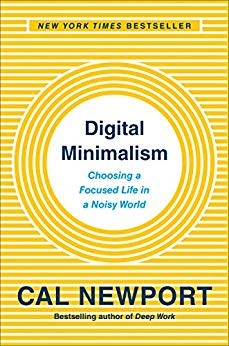
The Book in One Sentence
- Digital Minimalism is a philosophy of technology in which you focus your online time on a few carefully selected activities that support the things you value.
The Five Big Ideas
- Digital Minimalism:“A philosophy of technology use in which you focus your online time on a small number of carefully selected and optimized activities that strongly support things you value, and then happily miss out on everything else.”
- Digital Declutter:A practice in which you define your technology rules, take a thirty-day break, and reintroduce technology.
- Solitude Deprivation:A state in which you spend close to zero time alone with your own thoughts and free from input from other minds.
- The Social Media Paradox: Social media makes you feel both connected and lonely, happy and sad.
- The Bennett Principle:A practice in which you prioritize demanding activity over passive consumption, use skills to produce valuable things in the physical world, and seek activities that require real-world, structured social interactions.
Digital Minimalism Summary
Introduction
Newport is convinced that we need “a full-fledged philosophy of technology use, rooted in your deep values, that provides clear answers to the questions of what tools you should use and how you should use them and, equally important, enables you to confidently ignore everything else.”
A Lopsided Arms Race
“People don’t succumb to screens because they’re lazy, but instead because billions of dollars have been invested to make this outcome inevitable.”
It’s Newport’s contention that checking “likes” is the new smoking.
Addiction is defined as “a condition in which a person engages in the use of a substance or in a behavior for which the rewarding effects provide a compelling incentive to repeatedly pursue the behavior despite detrimental consequences.”
After reviewing the relevant psychology literature and interviewing relevant people in the technology world, author Adam Alter discovered that:
- Our new technologies are particularly well suited to foster behavioral addictions; and
- In many cases, these addictive properties of new technologies are carefully engineered design features.
Tech companies encourage behavioral addiction through:
- Intermittent positive reinforcement; and
- The drive for social approval.
Digital Minimalism: A Minimal Solution
Newport definesDigital Minimalismas, “A philosophy of technology use in which you focus your online time on a small number of carefully selected and optimized activities that strongly support things you value, and then happily miss out on everything else.”
“Minimalists don’t mind missing out on small things,” writes Newport. “What worries them much more is diminishing the large things they already know for sure make a good life good.”
Digital Minimalism Principles
- Principle #1:“Digital minimalists recognize that cluttering their time and attention with too many devices, apps, and services creates an overall negative cost that can swamp the small benefits that each individual item provides in isolation.”
- Principle #2:“Digital minimalists believe that deciding a particular technology supports something they value is only the first step. To truly extract its full potential benefit, it’s necessary to think carefully about how they’ll use the technology.”
- Principle #3:“Digital minimalists derive significant satisfaction from their general commitment to being more intentional about how they engage with new technologies. This source of satisfaction is independent of the specific decisions they make and is one of the biggest reasons that minimalism tends to be immensely meaningful to its practitioners.”
The Digital Declutter: On (Rapidly) Becoming Minimalist
Here’s how Newport describes what he calls, The Digital Declutter Process:
Put aside a thirty-day period during which you will take a break from optional technologies in your life. During this thirty-day break, explore and rediscover activities and behaviors that you find satisfying and meaningful. At the end of the break, reintroduce optional technologies into your life, starting from a blank slate. For each technology you reintroduce, determine what value it serves in your life and how specifically you will use it so as to maximize this value.
Put aside a thirty-day period during which you will take a break from optional technologies in your life. During this thirty-day break, explore and rediscover activities and behaviors that you find satisfying and meaningful. At the end of the break, reintroduce optional technologies into your life, starting from a blank slate. For each technology you reintroduce, determine what value it serves in your life and how specifically you will use it so as to maximize this value.
There are three steps to The Digital Declutter Process:
Step #1: Define Your Technology Rules
- “The digital declutter focuses primarily on new technologies, which describes apps, sites, and tools delivered through a computer or mobile phone screen. You should probably also include video games and streaming video in this category.”
- “Take a thirty-day break from any of these technologies that you deem ‘optional’—meaning that you can step away from them without creating harm or major problems in either your professional or personal life. In some cases, you’ll abstain from using the optional technology altogether, while in other cases you might specify a set of operating procedures that dictate exactly when and how you use the technology during the process. In the end, you’re left with a list of banned technologies along with relevant operating procedures. Write this down and put it somewhere where you’ll see it every day. Clarity in what you’re allowed and not allowed to do during the declutter will prove key to its success.”
Step #2: Take a Thirty-Day Break
- “You will probably find the first week or two of your digital declutter to be difficult, and fight urges to check technologies you’re not allowed to check. These feelings, however, will pass, and this resulting sense of detox will prove useful when it comes time to make clear decisions at the end of the declutter. The goal of a digital declutter, however, is not simply to enjoy time away from intrusive technology.”
- “During this month-long process, you must aggressively explore higher-quality activities to fill in the time left vacant by the optional technologies you’re avoiding. This period should be one of strenuous activity and experimentation. You want to arrive at the end of the declutter having rediscovered the type of activities that generate real satisfaction, enabling you to confidently craft a better life—one in which technology serves only a supporting role for more meaningful ends.”
Step #3: Reintroduce Technology
After reintroducing technology, ask yourself,
- Does this technology directly support something that I deeply value?
- Is this technology the best way to support this value?
- How am I going to use this technology going forward to maximize its value and minimize its harms?
To allow an optional technology back into your life at the end of the digital declutter, it must:
- Serve something you deeply value (offering some benefit is not enough);
- Be the best way to use technology to serve this value (if it’s not, replace it with something better); and
- Have a role in your life that is constrained with a standard operating procedure that specifies when and how you use it.
Spend Time Alone: When Solitude Saved The Nation
In Chapter 4, Newport introduces a problem calledSolitude Deprivation: A state in which you spend close to zero time alone with your own thoughts and free from input from other minds.
To combat Solitude Deprivation, practice leaving your phone at home, taking long walks, and writing letters.
Don’t Click “Like”
When given downtime, our brains default to thinking about our social life.
The loss of social connection triggers the same system as physical pain.
“Social media is either making us lonely or bringing us joy.”
“The more you use social media to interact with your network, the less time you devote to offline communication.”
The more you use social media, the less time you tend to devote to offline interaction, meaning you’re more likely to feel lonely and miserable. As Newport writes, “The small boosts you receive from posting on a friend’s wall or liking their latest Instagram photo can’t come close to compensating for the large loss experienced by no longer spending real-world time with that same friend.”
According to Newport, to succeed with digital minimalism, you have to confront this rebalancing between conversation—the much richer, higher bandwidth communication that defines real-world encounters between humans—and connection—low-bandwidth interactions that define our online social lives—in a way that makes sense to you. (Note: Newport borrows the above distinction from MIT professor Sherry Turkle.)
Newport explains,
The philosophy of conversation-centric communication argues that conversation is the only form of interaction that in some sense counts toward maintaining a relationship. This conversation can take the form of a face-to-face meeting, or it can be a video chat or a phone call—so long as it matches Sherry Turkle’s criteria of involving nuanced analog cues, such as the tone of your voice or facial expressions. Anything textual or non-interactive—basically, all social media, email, text, and instant messaging—doesn’t count as conversation and should instead be categorized as mere connection.
The philosophy of conversation-centric communication argues that conversation is the only form of interaction that in some sense counts toward maintaining a relationship. This conversation can take the form of a face-to-face meeting, or it can be a video chat or a phone call—so long as it matches Sherry Turkle’s criteria of involving nuanced analog cues, such as the tone of your voice or facial expressions. Anything textual or non-interactive—basically, all social media, email, text, and instant messaging—doesn’t count as conversation and should instead be categorized as mere connection.
To subscribe to conversation-centric communication, avoid clicking the “like” button or posting comments on social media, consolidate texting, and hold conversation office hours.
Reclaim Leisure: Leisure and The Good Life
“A life well-lived requires activities that serve no other purpose than the satisfaction that the activity itself generates.”
“If you begin decluttering the low-value digital distractions from your life before you’ve convincingly filled in the void they were helping you ignore, the experience will be unnecessarily unpleasant at best and a massive failure at worse.”
To follow what Newport calls, The Bennett Principle:
- Prioritize demanding activity over passive consumption;
- Use skills to produce valuable things in the physical world; and
- Seek activities that require real-world, structured social interactions.
Newport suggests trying to learn and apply one new skill every week, over a period of six weeks.
Join the Attention Resistance: David and Goliath 2.0
The “attention economy” describes the business sector that makes money-gathering consumers’ attention and then repackaging and selling it to advertisers.
To join The Attention Resistance:
- Delete social media from your phone;
- Turn your devices into single-purpose computers;
- Use social media like a professional;
- Embrace slow media; and
- Dumb down your smartphone.
Books Mentioned
- Drunk Tank Pink: And Other Unexpected Forces That Shape How We Think, Feel, and Behaveby Adam Alter
- Irresistible: The Rise of Addictive Technology and the Business of Keeping Us Hookedby Adam Alter
- Reclaiming Conversation: The Power of Talk in a Digital Ageby Sherry Turkle
- Waldenby Henry Thoreau
- What Technology Wantsby Kevin Kelly
- How to Live on 24 Hours a Dayby Arnold Bennett
- Handmade: Creative Focus in the Age of Distractionby Gary Rogowski
- The Attention Merchants: The Epic Scramble to Get Inside Our Headsby Tim Wu
Recommended Reading
If you likeDigital Minimalism, you might also like:
- Atomic Habits: Tiny Changes, Remarkable Resultsby James Clear
- Deep Work: Rules for Focused Success in a Distracted Worldby Cal Newport
- Getting Things Done: The Art of Stress-Free Productivityby David Allen
Buy The Book: Digital Minimalism
Hardcover
Related Lists
- Business Book Summaries
- Psychology Book Summaries
- Self-Help Book Summaries
Or,browse more book summaries.
Back to All Book Summaries