Sam’s Five Favorite Ideas
- Long Words Don’t Always Make You Sound More Intelligent
- Is Your Copy FAB?
- Another Headline Idea: True or False
- I Object
- Tap Into People’s Aspirations
1. Long Words Don’t Always Make You Sound More Intelligent
Some of us like to think that using long, polysyllabic words makes us sound intelligent. But we’re wrong in that assertion. Intelligence alone doesn’t move the reader to take action: clarity does. Why? Because if the reader doesn’t understand you, they’re unlikely to buy from you (no matter how intelligent you might be).
Maslen references an article fromThe Economistto illustrate his point. In a piece published during the 2008 American presidential race, Maslen noticed that among the polysyllabic words (anathema, insinuate, redoutable), there were simpler, more common words (dodgy, grumpy, sizzling).
His contention is that copywriters don’t use long words to make themselves sound smart, but rather, to keep their writing brief and concise. In other words, they will only use a long word if a shorter one won’t do.
Bottom line? You can, and should, use long words at times (depending on who you’re writing for, of course), but keep in mind: copy is about the reader, not you.
2. Is Your Copy FAB?
In the end scene ofThe Wolf of Wall Street, Leonardo DiCaprio asks an attendee of a seminar he’s speaking at to sell him a pen. The attendee stammers and then describes the pen and who it’s for. DiCaprio smiles and asks another attendee, and then another, and another, before the movie fades to black.
Like the oblivious seminar attendees, most would-be copywriters often fall into the trap of describing a product’s features—what it does, who it’s for, the material(s) it’s constructed from. This is a mistake, and a costly one at that. People don’t care what a product does, unsurprisingly; they care about what it can do for them.
One formula that helps tap into a prospect’s self-interest is FAB, which stands for Features, Advantages, Benefits. Features are what things are. Advantages are how those features make a product better than a competitor’s. Benefits answer the customer’s questions, “What’s in it for me?”
To quote Maslen, “If you can hear your customers saying, ‘So what?,’ you’re not talking benefits.”
3. Another Headline Idea: True or False
Writing headlines is tough. Writing good headlines is tougher. But writing headlines for a product that’s unexpected, unknown, or new? That’s a real challenge.
One headline idea for products that fall under that category is to ask a question that addresses potential ignorance head-on, without making the reader feel stupid.
For example, for a weight loss product, you might write, “You can lose weight without giving up cream cakes, true or false?” Then, in the body copy, you might follow up with, “It’s true.” before explaining why.
One particular advantage of this headline idea is, if pulled off correctly, it can be highly memorable. If the headline is all the prospects reads, they’re still likely to remember the right answer: yes, you can.
4. I Object
When writing copy, it’s not enough to convince the buyer to say yes by writing about benefits alone. Buyers, for the most part, are skeptical by nature, and for that reason, you have to raise—and overcome—objections that prevent them from taking action.
Objections vary from industry to industry and from product to service. What might be an objection to your product might not be for someone else. There are three objections, though, that are more common than others, which Maslen addresses in his book.
First, there’s “It’s too expensive” If a prospect says this, you need to demonstrate the value of your product by showing how much they will save or make, versus the cost.
Second, there’s “I need to talk to someone else.” If heard, Maslen urges you to show the prospect what they could lose by hanging back and sharing testimonials from people like them. (More on that below.)
Third, there’s “I’m not sure I really need this.” If you hear this objection, it’s for one reason: you haven’t sold well enough. Maybe your benefits aren’t strong enough. Maybe it’s the wrong product for the wrong prospect. Whatever the reason, update and improve your copy until it’s no longer a concern.
Further Reading
For more on raising and overcoming objections, readThe Ultimate Sales Letterby Dan Kennedy.
5. Tap Into People’s Aspirations
HM Revenue and Customers (HMRC) had a problem. At the end of each financial year, UK taxpayers received a letter reminding them to return their declarations on time. Yet, despite penalties for late returns, few returned their declarations on time.
To reduce delays, the HMRC contacted the authors of the bookYes!after hearing about an experiment that helped hotels reduce towel usages. The results were remarkable. When the authors added an additional sentence in the letter referring to the large number of people living in the same postcode paid their taxes on time, tax returns increased by 12 percent.
To quote the authors, “The more similar the person giving [a] testimonial is to the new target audience, the more persuasive the message becomes.”
You can apply a similar technique in your copy. When selling luxury goods, Maslen suggests focusing more on who is already benefiting from your product. For instance, you might write, “Here’s what other readers—like you—are saying about my work.”
Testimonials are effective, but when highlighting people who are similar to the reader, the results can often convince even the most skeptical of buyers.
Books Mentioned
- How to Write Sales Letters that Sellby Drayton Bird
- The Secrets of Effective Direct Mailby John Fraser-Robinson
- Advertising That Pulls Responseby Graeme McCorkell
- The Solid Gold Mailboxby Walter Weintz
- How to Write a Good Advertisementby Victor Schwab
- Tested Advertising Methodsby John Caples
- The Adweek Copywriting Handbookby Joseph Sugarman
- The Copywriter’s Handbookby Robert Bly
- Commonsense Direct and Digital Marketingby Drayton Bird
- Reality in Advertisingby Rosser Reeves
- Now That’s Funny!by David Bradbury
Recommended Reading
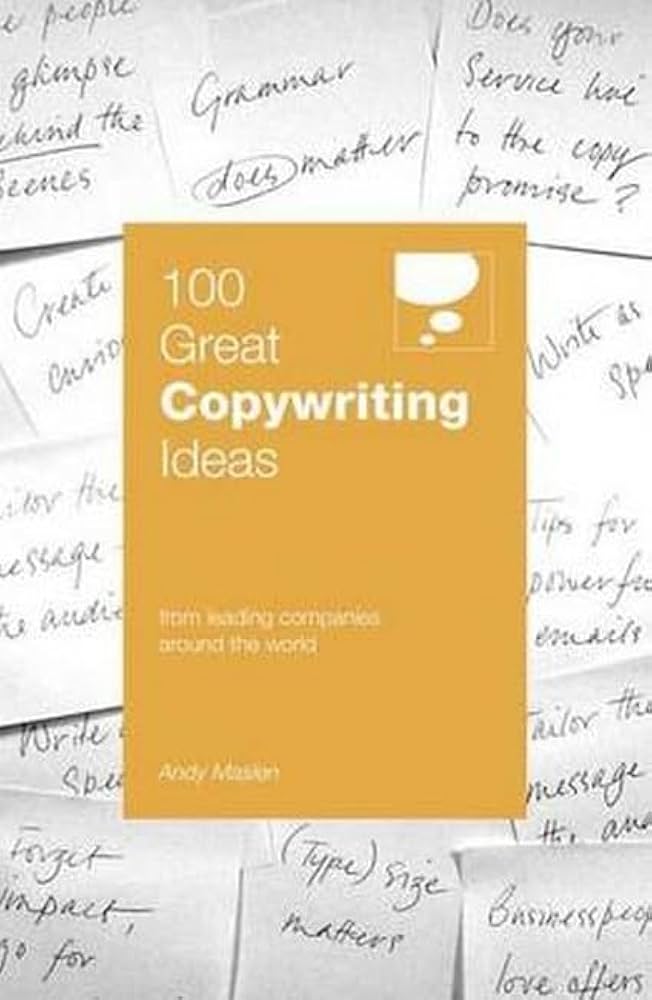
If you like100 Great Copywriting Ideas, you might also like:
- Contagiousby Jonah Berger
- No B.S Time Management for Entrepreneursby Dan Kennedy
- The Adweek Copywriting Handbookby Joseph Sugarman
Buy The Book: 100 Great Copywriting Ideas
Print|Kindle
Related Lists
- Business Book Summaries
- Psychology Book Summaries
- Self-Help Book Summaries
Or,browse more book summaries.
Back to All Book Summaries